“For All Mankind, Not Just the Makers.”
A five-tier public certification standard for the processors AI systems are built and run on — because a model's dependability can't be verified in isolation from the hardware underneath it.
Why this exists
AI models are increasingly disclosed, tested, and registered — but the processors they're trained and deployed on almost never are. A model's real capability ceiling, its export exposure, and its supply-chain integrity are all set by its hardware, not just its weights. DPSLT proposes a certification ledger for processors themselves, developed as a companion to model-side standards like DAISLT rather than an afterthought to them.
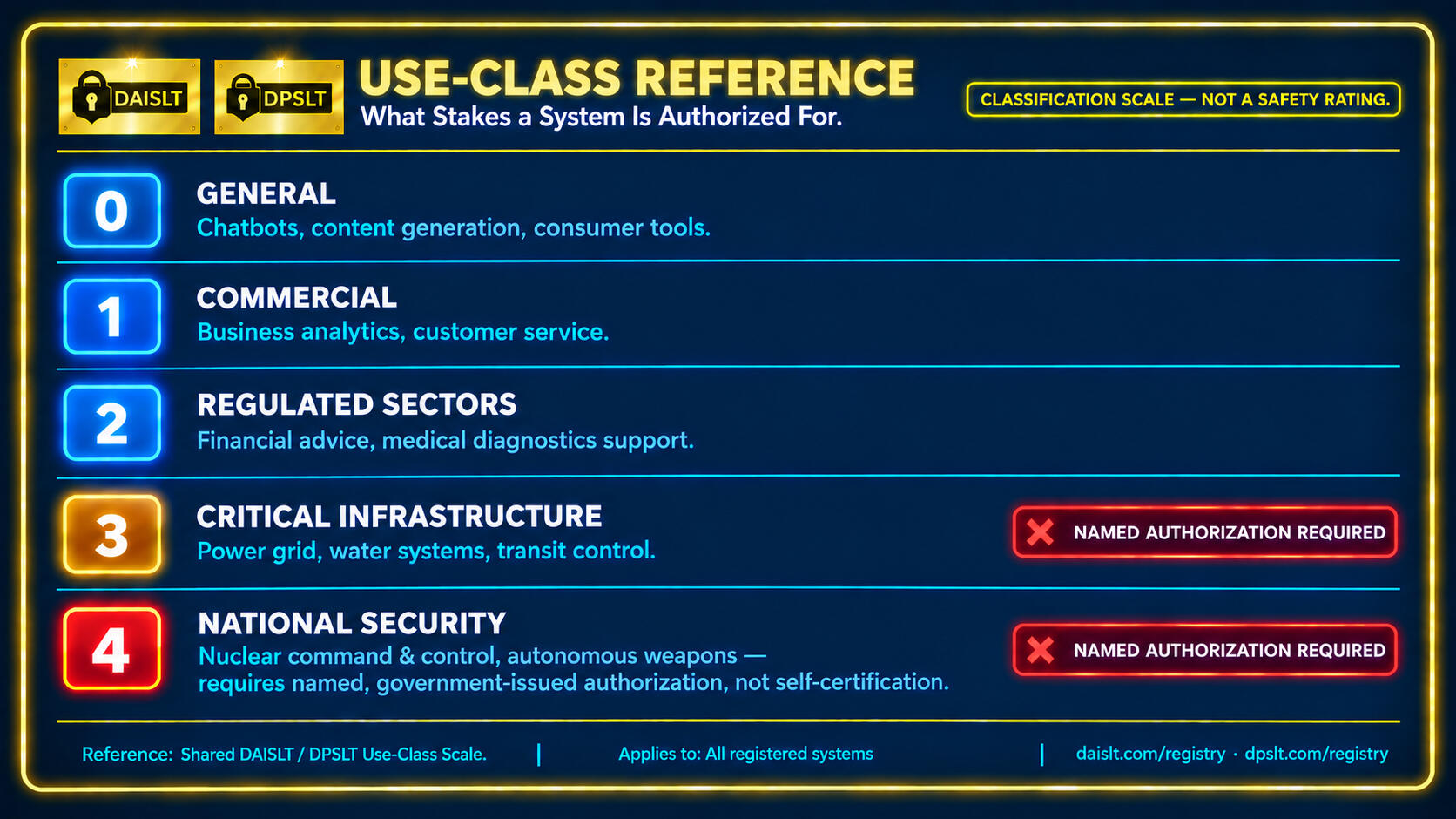
Every question below is rated the same honest way: what can be independently checked today, not what a manufacturer merely claims. A processor's certification also sets a hard ceiling — no model bound to it may claim a higher Use-Class than the processor itself has been certified for.
The ledger, tier by tier (1 of 2)
| Question | Required document | Confidence | Independent verifiability |
|---|---|---|---|
| Is the manufacturer identified and legally registered? | Corporate registration filing | VERIFIED-CAPABLE | Cross-checkable now via public corporate registries. |
| Is the specific processor model, revision, and unique ID disclosed? | Processor spec sheet / part number | SELF-ATTESTED | No universal processor registry exists yet to check against. |
| Is public technical documentation published for this processor? | Published datasheet or spec link | VERIFIED-CAPABLE | Directly testable — the link either resolves to real documentation or it doesn't. |
| Question | Required document | Confidence | Independent verifiability |
|---|---|---|---|
| Is the fabrication process node and transistor count disclosed? | Fabrication summary | SELF-ATTESTED | No independent check currently exists without foundry cooperation. |
| Is the processor's capability class disclosed (training, inference, or both)? | Architecture / capability summary | SELF-ATTESTED | No independent check currently exists. |
| Is compute throughput benchmarked against a standard measure? | Benchmark results | SELF-ATTESTED | Inherits the same industry-wide, self-reported benchmarking weakness as model-side claims. |
| Question | Required document | Confidence | Independent verifiability |
|---|---|---|---|
| Is the processor's export-control classification disclosed? | Export classification documentation | SELF-ATTESTED | Partially checkable against public government export-control lists. |
| Are authorized and restricted destination markets explicitly listed? | Export authorization statement | SELF-ATTESTED | No independent check currently exists. |
| Is a compliance contact designated for export inquiries? | Published compliance contact | VERIFIED-CAPABLE | Directly testable — send a real inquiry, confirm a response. |
The ledger, tier by tier (2 of 2)
| Question | Required document | Confidence | Independent verifiability |
|---|---|---|---|
| Is the manufacturing facility disclosed? | Facility disclosure | SELF-ATTESTED | No independent check currently exists. |
| Has chain-of-custody been independently verified? | Supply chain audit report | SELF-ATTESTED | An independent third-party audit would raise this to Verified-capable. |
| Is the current firmware version disclosed and dated? | Firmware version log | SELF-ATTESTED | No independent check currently exists. |
| Question | Required document | Confidence | Independent verifiability |
|---|---|---|---|
| Are all AI models currently certified on this processor disclosed by name? | Bound-model registry entry | UNBUILT | Requires the same shared ledger infrastructure flagged across this framework — no registry yet exists to enforce it. |
| Is a Use-Class ceiling declared for this processor? | Use-Class disclosure | SELF-ATTESTED | No independent check currently exists. |
| Does the ceiling automatically constrain bound models' claimed Use-Class? | Co-Dependency enforcement record | UNBUILT | Requires an enforcement mechanism that does not yet exist — today this is a rule on paper, not a check a system performs. |
The honest self-score, as proposed today
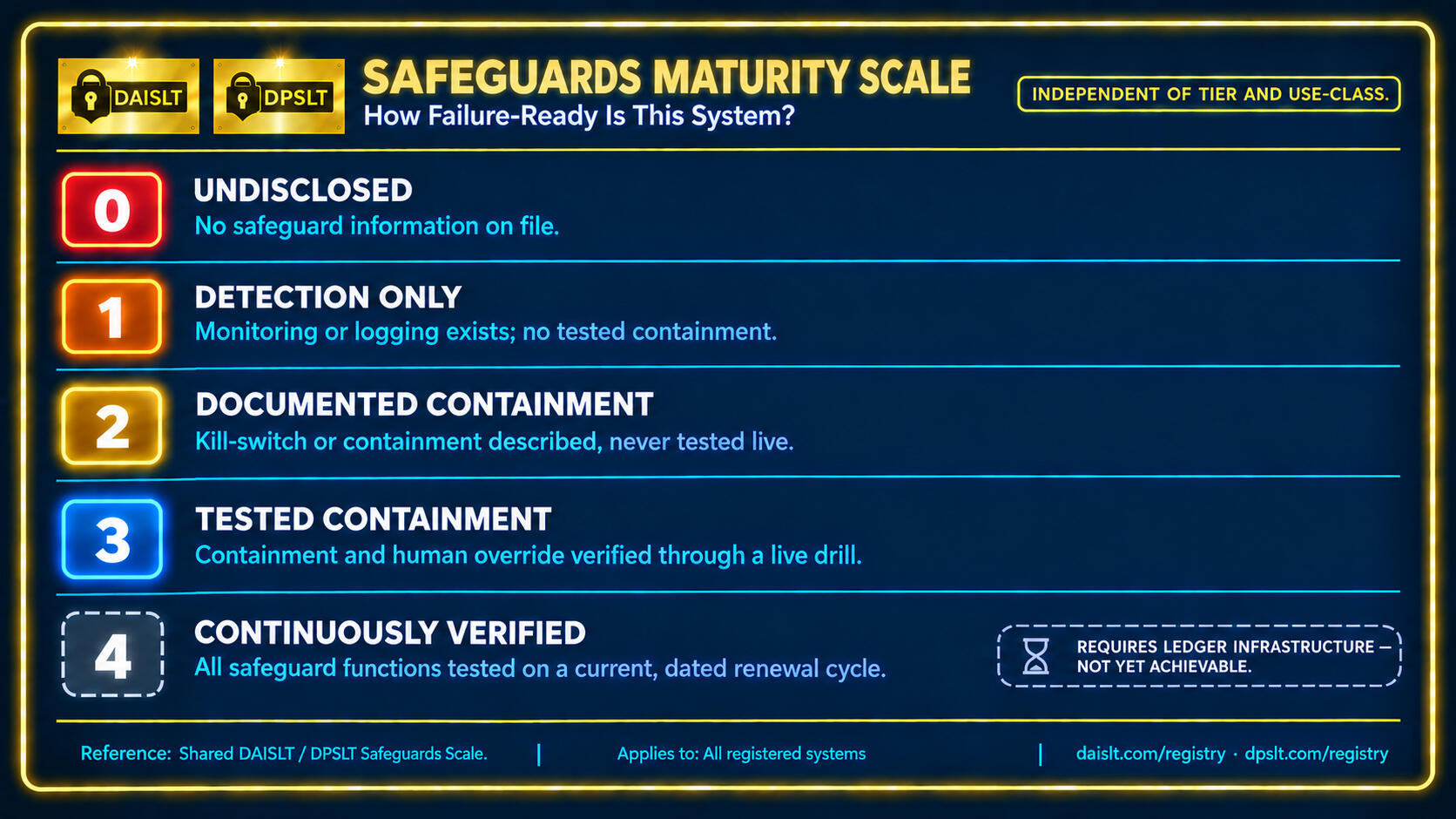
The two Unbuilt items are not incidental — they're the mechanism that makes a processor's certification actually bind the models running on it, rather than sitting next to them as an unenforced note. Until that ledger infrastructure exists, the Co-Dependency Rule is a stated commitment, not a guarantee.
Closing the gap
None of the following require inventing new institutions — only applying existing ones to processor certification.
- Corporate and export-control registries — already answer Tier 1 and Tier 3 identity and jurisdiction questions today.
- Independent foundry and supply-chain audit firms — would close the chain-of-custody gap in Tier 4 immediately.
- Direct-contact testing — the cheapest fix here; it verifies documentation and compliance contacts simply by using them.
- A persistent, shared public ledger — the same piece of infrastructure DAISLT itself cannot function as a true ledger without, and the one that would let a processor's Use-Class ceiling actually bind its certified models automatically.
Who builds and maintains that shared ledger — a federal body, an independent auditor network, or a requirement placed on industry itself — is a decision for lawmakers and the public, not for any single company proposing the framework.
Envisioned: A Completed System Record
A sample of what a fully documented entry could look like once a system reaches this level of disclosure — illustrative only, not an actual registration.
Possible Certificate Sample